Greener

Portfolio project · Experiment · 3D

Can a fly play Tetris?

I gave a fruit fly a keyboard. Nothing is trained. It plays badly.

318 real neurons13,620 real connections39 real body parts0 training
What
A live 3D experiment in the browser
My role
Idea, 3D scene, simulation, interface
Made with
JavaScript, three.js, Python
Year
2026
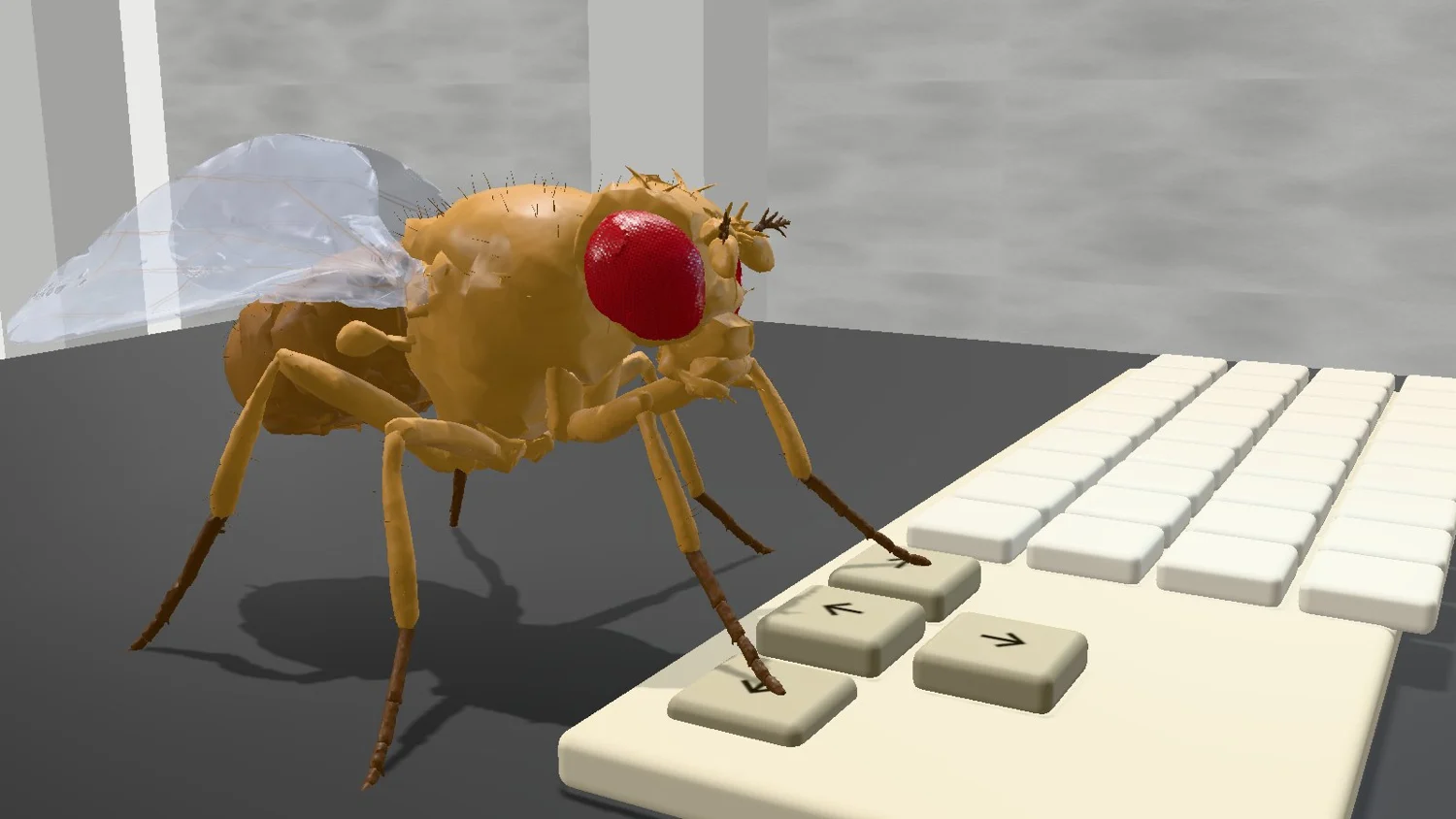
A 3D fruit fly with red compound eyes, its front leg pressing an arrow key
01

Why I made it

Scientists have mapped every connection in a fly's brain. So what would it do with a keyboard?

It started on Instagram. I kept seeing people making things with a fly's brain, and I wanted to know how. Looking into it led me to the study behind it: researchers have mapped the complete wiring of a fruit fly's nervous system, every neuron and every synapse, and released it for anyone to use.

I found that fascinating, and I wanted to see if I could do something with it myself. The concept I came up with was the most ridiculous honest test I could think of: take the real wiring, plug the fly's eyes into a game of Tetris, connect its own command neurons to the arrow keys, and just watch.

It's a quick, silly, free project, but it's built on real science, and it's honest about what it is: an art piece and a toy, not a neuroscience result.

02

How the fly plays

The fly's brain is a 318-neuron slice cut from a complete map of a real fly's nervous system. Every connection weight is a real synapse count. I chose the slice to run from the cells in its eyes that detect looming objects to the cells that send commands down to its body, so signals have a real path from what it sees to what it does.

01The board

Falling blocks loom bigger as they drop, and tall stacks loom too. The left eye watches the left half of the board, the right eye the right.

02The eyes

60 looming detectors, LC4 and LPLC2: the cells that fire when something is about to hit the fly.

03The brain

240 neurons on the strongest real paths, simulated every 0.1 ms as spiking neurons.

04The keys

18 descending neurons. Whichever group is most unusually active presses its key.

←Move leftLeft turning cells: DNa02, DNa11, DNg13
→Move rightRight turning cells, the same types
↑RotateWalk-forward cells: DNp09, DNg100, DNg97
↓DropEscape cells: the giant fibre DNp01 and MDN

So a block dropping towards the fly can set off its escape reflex, and that slams the piece down. Which is roughly what a fly would do.

Live preview

Watch it play

The real thing, running live in your browser. Drag to move the camera, and hover the brain map in the corner to see each neuron.

Open full size ↗
03

The set

I first pictured a pixel fly at a desk, but it was stronger as something that feels real. So it became a real 3D fly at an old beige box computer, alone in a stark white, high-contrast room. My reference was Batman's garage in The Dark Knight: clean, empty and lit like a lab.

A slow cinematic camera drifts between six framed shots, and you can drag to take over at any time.

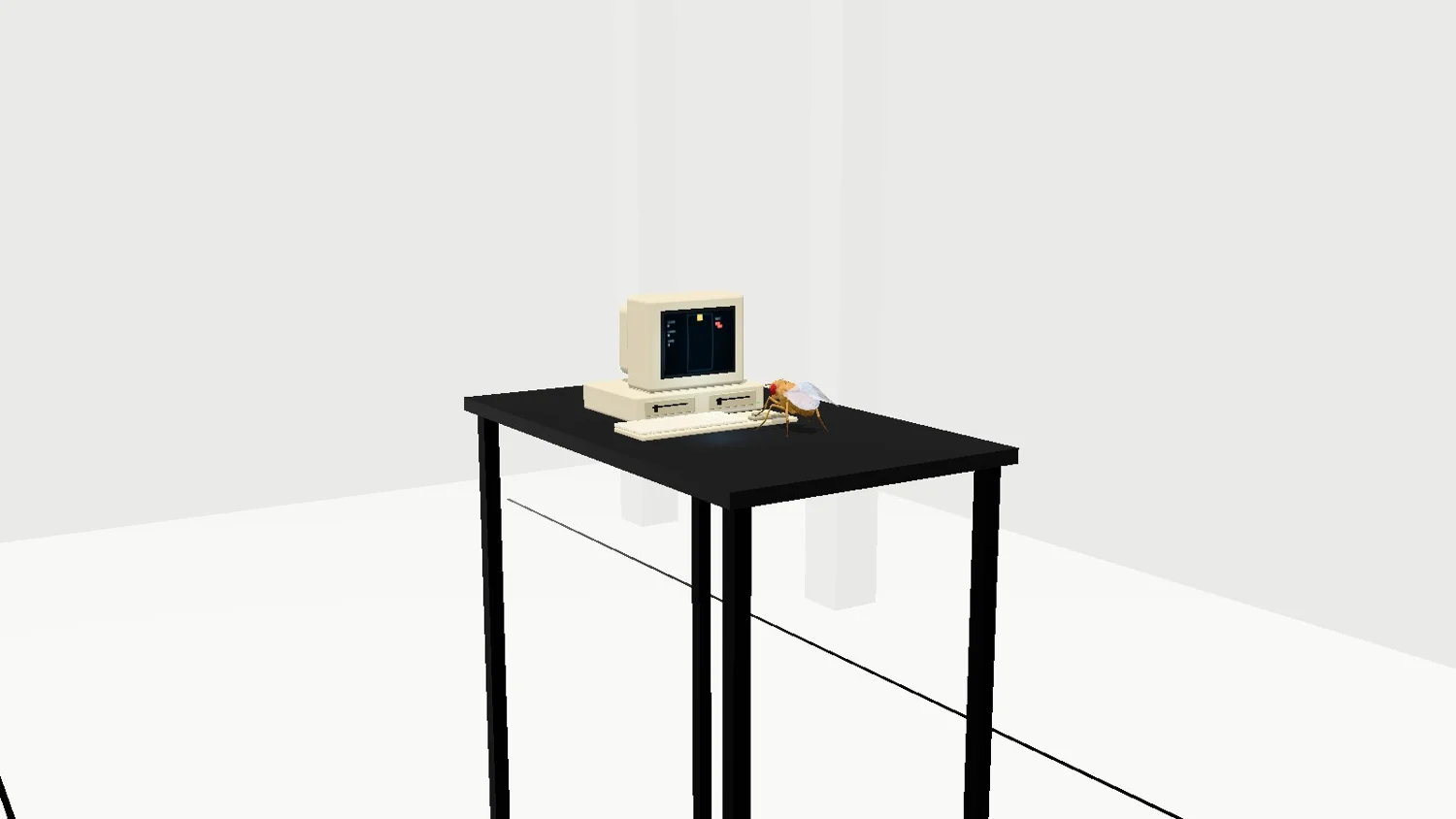
Wide shot: a black desk with a beige computer in a white room
The setup. One desk, one old computer, one fly.
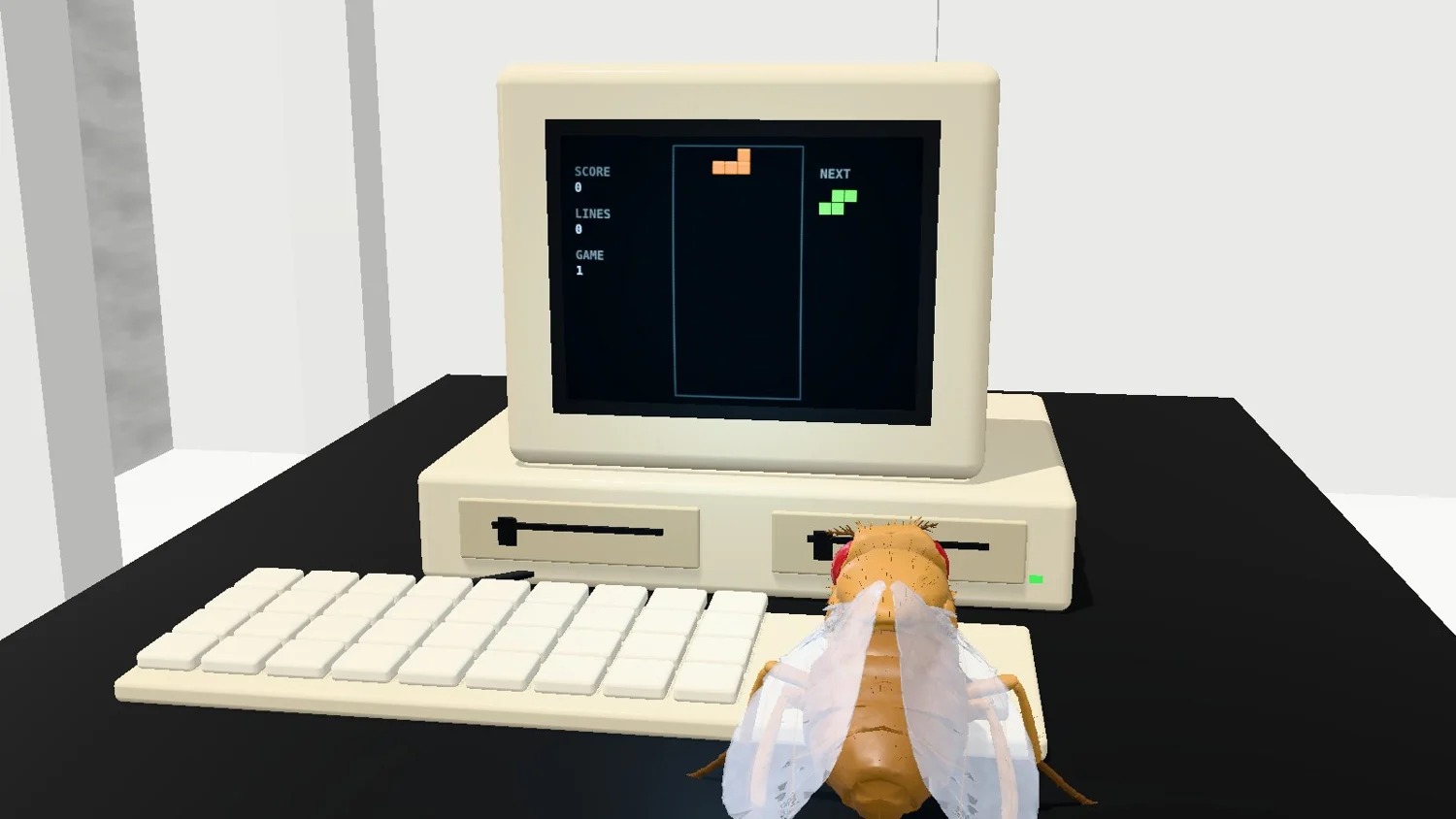
Over the fly's shoulder: Tetris on the CRT
Over the shoulder. The game runs live on the CRT.
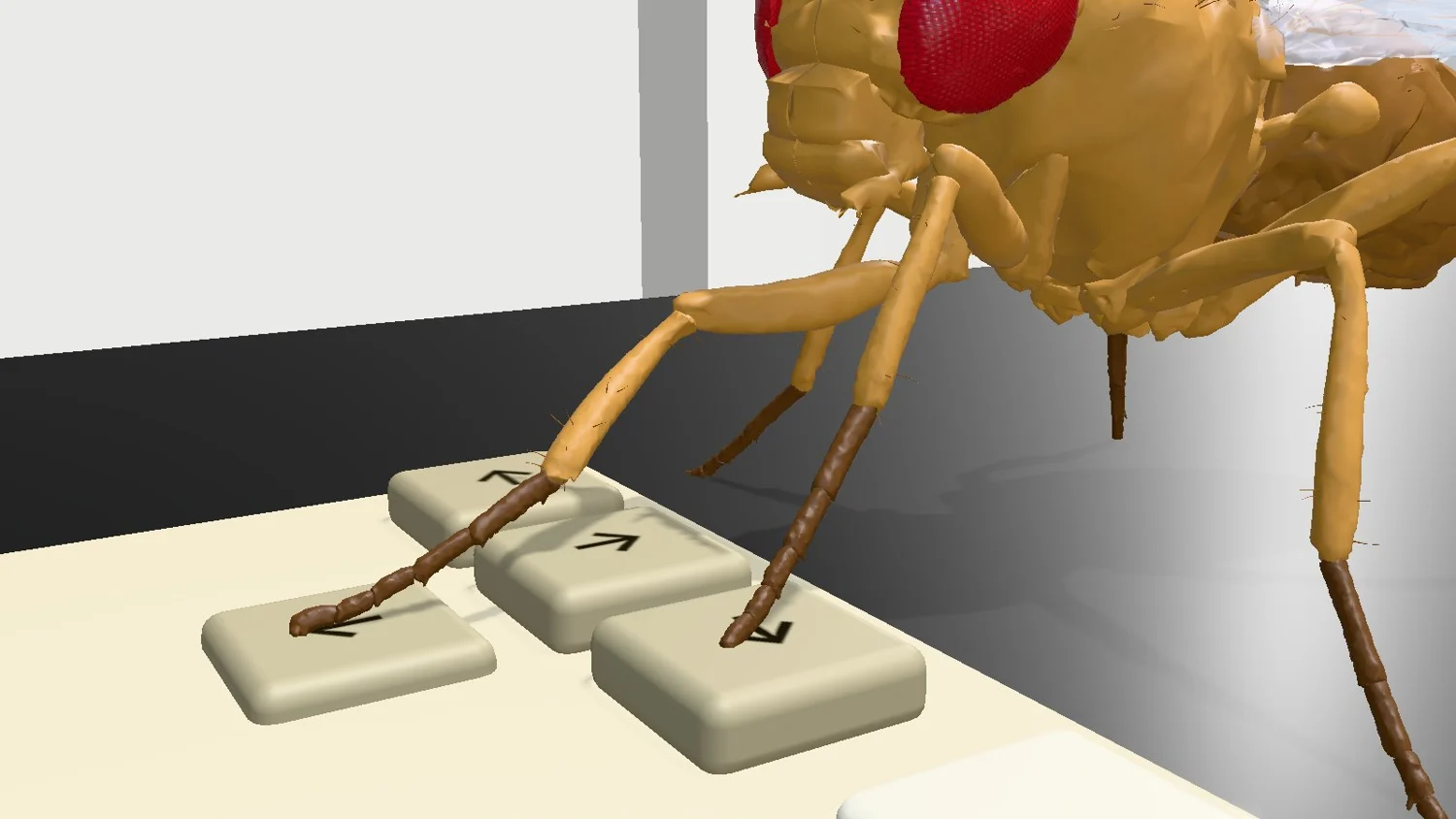
The fly's front legs on the arrow keys
The keys. Front legs placed with inverse kinematics.
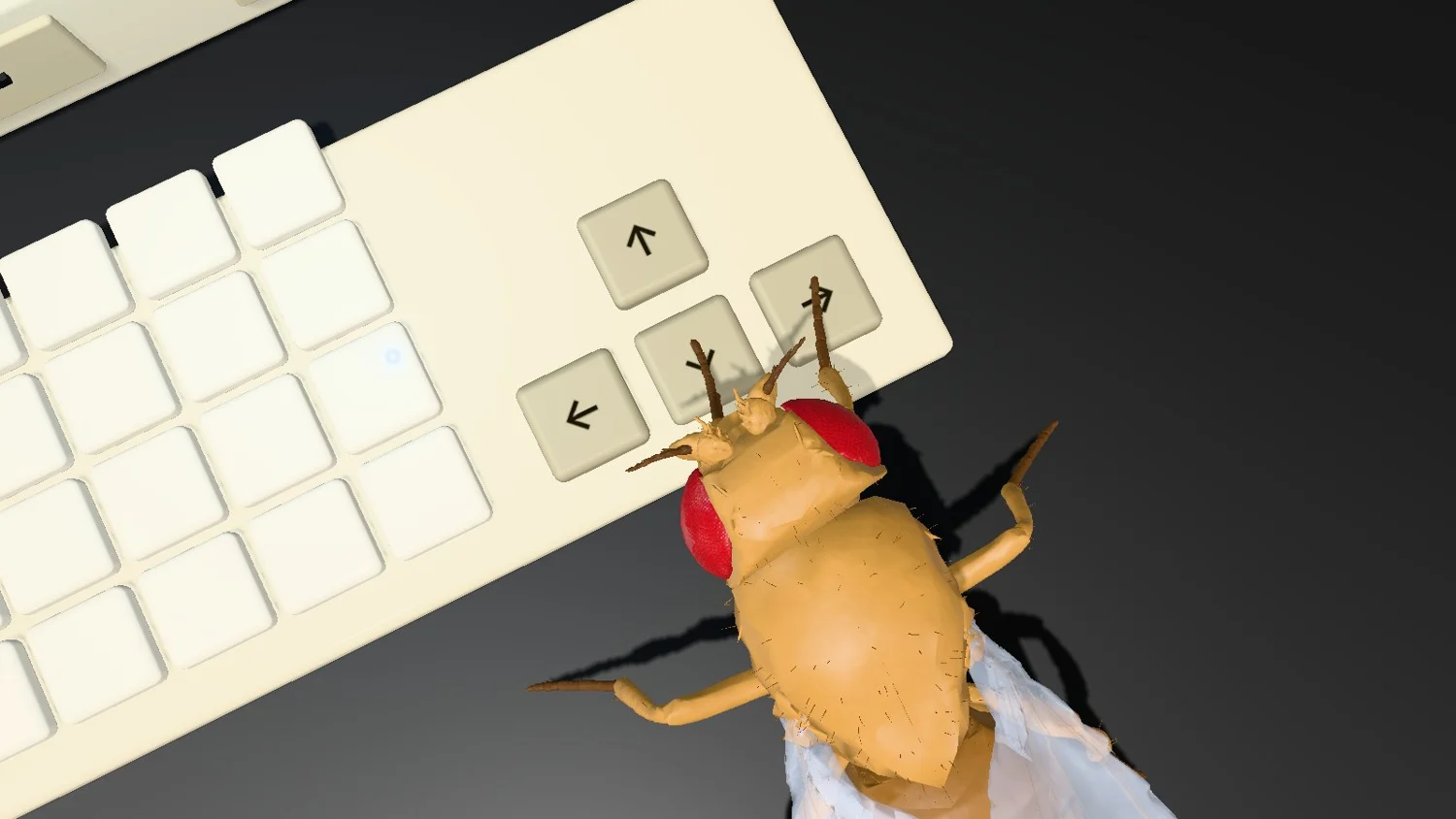
Top-down view of the fly at the keys
Top down. Feet on ← and →, ready to tap.
04

The small details

The full interface with the live brain map in the corner

The best bit

You can watch it think

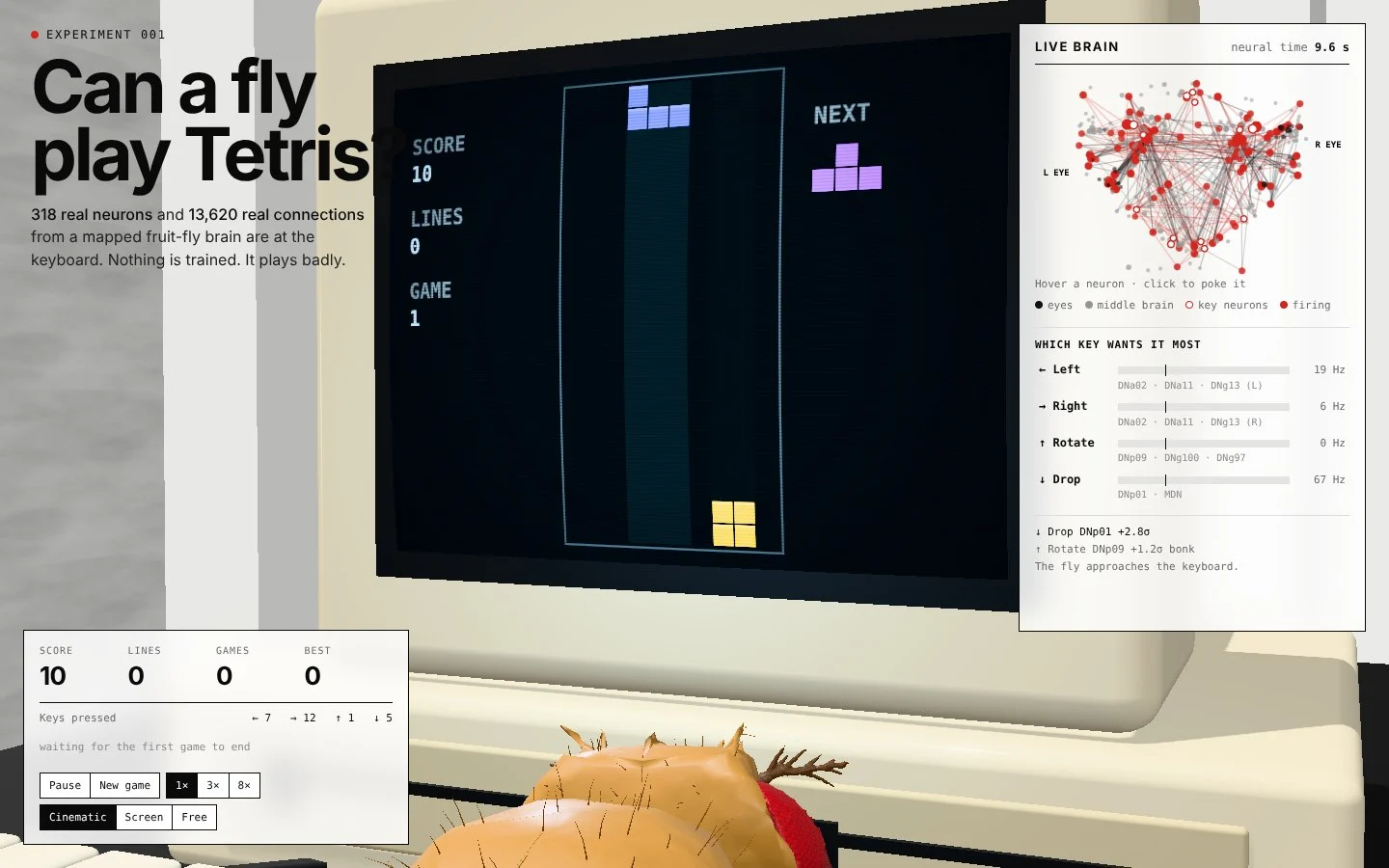
The panel in the corner is the fly's brain while it plays. Every dot is a neuron at its real position in the fly's head, flashing red when it fires, with lines tracing signals along its strongest connections. Hover a neuron to see its cell type and neurotransmitter, or click it to poke it and see what happens.

↓ Drop   DNp01 +2.8σ
← Left   DNa02 +1.9σ
↑ Rotate DNg100 +2.1σ
→ Right  DNg13 +1.6σ

Every key press is explained

A log shows why each key was pressed: which neuron group fired, and how far above its usual activity it was. The meters show which key's neurons are most excited at that moment.

rub
rub

It behaves like a fly

When it's idle it rubs its front legs together, the way flies do. Its antennae twitch, its abdomen breathes, and its wings flick when it slams the drop key.

A real fly body

The body is NeuroMechFly, rebuilt from microscope scans of a real fly: 39 parts on their measured skeleton. I added shaders for the facets of the compound eyes, the veins in the see-through wings and the cuticle texture, plus fine bristles scattered over the body.

Feet that stay on the keys

An inverse kinematics solver, kept within the real joint limits of a fly's leg, places the front feet on the keys while the middle and back feet stay planted on the desk.

What the fly sees

Faint blue columns on the CRT show what each eye is watching. And the screen itself glows like an old monitor, with scanlines and phosphor bloom.

0.1 ms

A real brain, in real time

The spiking simulation of 318 neurons and 13,620 synapses runs live on your computer's processor, stepped every tenth of a millisecond, using the same neuron model as a 2024 study in Nature.

05

Being honest about it

Projects like this are easy to oversell, so I wanted to be clear about which parts are science and which are my choices. A real fly would just fly away.

Real

  • The wiring: a slice of a mapped fly brain, with real synapse counts
  • The body: rebuilt from scans of a real fly
  • The neuron model, from published research

My design choices

  • How the Tetris board becomes input to the eyes
  • How neuron activity becomes key presses
  • How the legs move, and the whole scene

Built on open science: the MaleCNS connectome (FlyEM / HHMI Janelia, Cambridge, MRC LMB, Google Research, CC BY 4.0), the NeuroMechFly body (Apache-2.0), the neuron model from Shiu et al., Nature 2024, and preprocessing adapted from Xenova's fruit-fly simulation (MIT). Tetris is a trademark of The Tetris Company; this is an unaffiliated, non-commercial fan project.

06

How it's built

No framework and no build step: plain JavaScript and three.js, so you can open the page and it runs. Python tools cut the brain slice out of the full connectome and pack the fly's body for the web, and a script can fetch the full 1.1 GB dataset for anyone who wants to go further.

3Dthree.js, soft shadows, bloom
BrainSpiking neurons in plain JavaScript
DataPython tools for the slice and body
BuildNone. Open it and it runs
HarrisonGreener/can-a-fly-play-tetris- ↗
JavaScript 98.1%CSS 0.6%HTML 0.6%Python 0.6%